
A New Era in Physics
Fundamental Energy Theory FET – Theory of Everything
The Unified Master Equation (UME):
A Ward–Balanced Δ–Σ Vacuum with a Unique RG-Stable Fixed Point at α = 1.5
(Former title: A Dimensionless Constant α = 1.5 as the Foundation for a Theory of Everything)
– Mathematical Concept FET –
- Please note: The mathematical concept is still under development, and NCP X-AIONS will progressively follow up on Leif Pettersson’s ongoing work.
- Short text in Swedish at the end of this page / Kort text på svenska finns längst ner på denna sida.
Brief Introduction
 Albert Einstein, Stephen Hawking and many others have been and still are struggling with what they term a “Theory of Everything”, which, in a few words, means to capture the workings of the universe in one single equation. The original technical concept refers to the unification of the four fundamental forces of nature: gravity, electromagnetism, and the strong and weak nuclear forces into a single theory, which is one of the major unsolved problems in physics.
NCP X-AIONS published in 2012 the work of our collaborator, biochemical engineer Leif Pettersson, presenting ground-breaking material that is entirely based on Martinus Cosmology – The Cosmic Worldview: The Fundamental Energy Theory – FET, which conclusively unifies the four fundamental forces of nature and thereby meets the criteria for the Theory of Everything.
Physics, Martinus Cosmology and The Theory of Everything – The Fundamental Energy Theory – FET
Svensk utgåva: GrundEnergiTeorin – GET
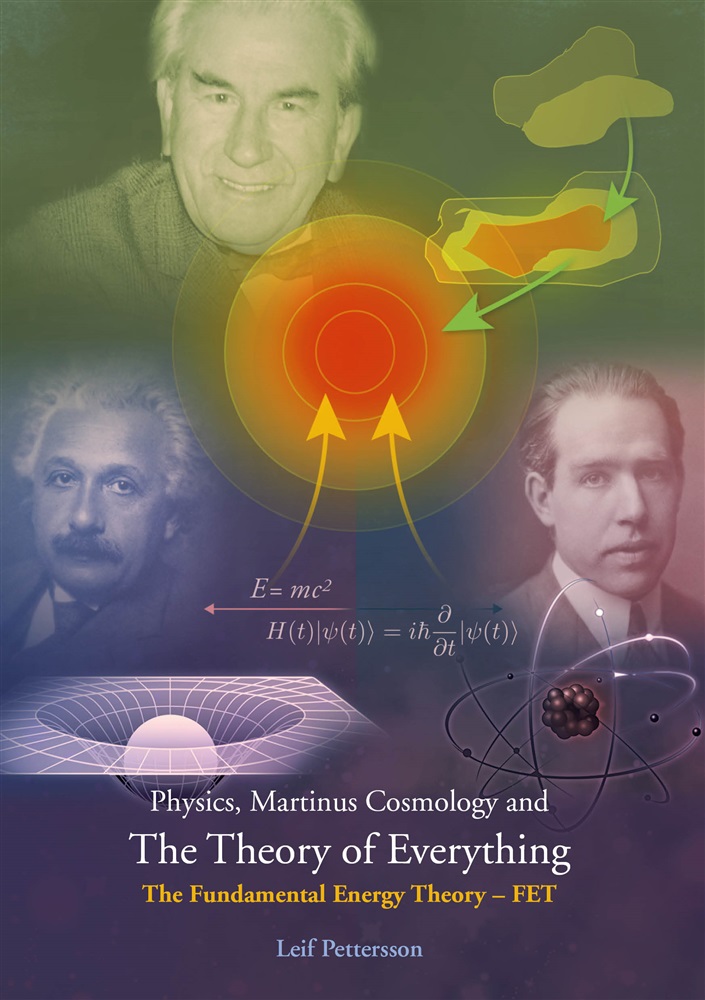
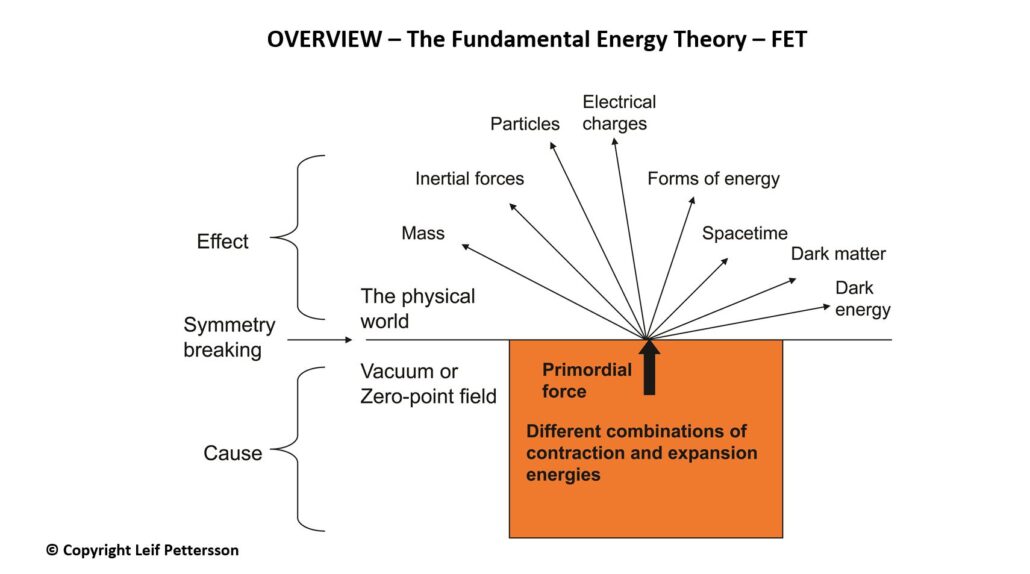
The Fundamental Energy Theory – FET, Overview figure 26
Leif Pettersson bases his concept primarily on two of the cosmic qualitative basic energies: the expansion energy and the contraction energy, their properties, and the interaction and tension between these two opposing energies.
In the automn of 2025, thirteen years after the book’s publication, Leif Pettersson introduced a completely new mathematical concept that supports FET and presents a Theory of Everything:
The Unified Master Equation (UME):
A Ward–Balanced Δ–Σ Vacuum with a Unique RG-Stable Fixed Point at α = 1.5
Former title: A Dimensionless Constant α = 1.5 as the Foundation for a Theory of Everything
The mathematical concept is still under development, and NCP X-AIONS will progressively follow up on Leif Pettersson’s ongoing work.
Below you find a short summary of UME in English (and a link to Swedish), followed by the original abstract and a link to the article. The first version was published on September 22, 2025, at Zenodo, the University of Ghent.
We are very pleased and grateful to present Pettersson’s innovative and revolutionary material on this page!
Further information will be provided gradually.
Very Brief Summary of The Unified Master Equation (UME):
A Ward–Balanced Δ–Σ Vacuum with a Unique RG-Stable Fixed Point at α = 1.5
Former title: Dimensionless Constant α = 1.5 as the Foundation for a Theory of Everything
The Unified Master Equation (UME) introduces a framework that unifies gravitational, quantum, and cosmological dynamics through an asymmetry parameter α = 1.5, treated not as a free variable but as a fundamental constant derived from the vacuum structure (Δ–Σ). This imbalance replaces the need for fine-tuned cosmological parameters and offers ab initio derivations of multiple observables such as the fine-structure constant, electron–proton mass ratio, neutrino masses, and the Hubble function H(z).
UME successfully addresses black hole unitarity, singularity resolution, and dark matter/energy unification. It also incorporates a novel metaphysical structure with observer O, quantum vacuum Q, and spacetime sector S, suggesting that consciousness is located outside spacetime and acts as a projector of reality.
UME’s predictions are falsifiable: it anticipates the existence of a Δ-boson, deviations in gravitational wave signatures, and cosmological anomalies, offering a robust and testable approach to a Theory of Everything.


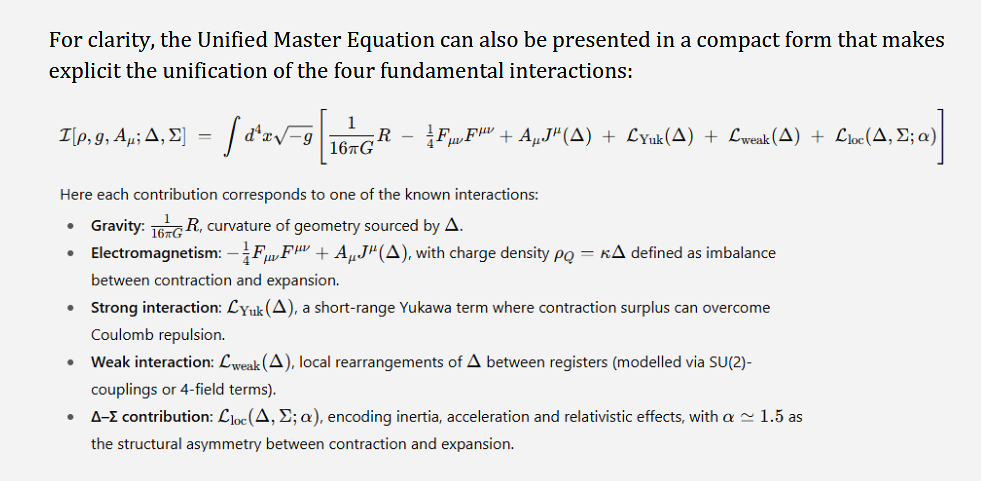
The Unified Master Equation (UME):
A Ward–Balanced Δ–Σ Vacuum with a Unique RG-Stable Fixed Point at α = 1.5
Former title:
A Dimensionless Constant α = 1.5 as the Foundation for a Theory of Everything
Leif Pettersson
10.5281/zenodo.18161847
https://zenodo.org/records/18161847
version 5-33
Abstract (updated version 5-33, April, 2026)
We present the Unified Master Equation (UME), a parameter-free framework in which the vacuum ratio α = Δ/Σ is not assumed but derived as the unique Ward-balanced, RG-stable fixed point. Only two opposite vacuum fields, Δ and Σ, are assumed, with no imposed symmetry breaking or predefined asymmetry; the ratio α emerges dynamically. A supersymmetric Δ–Σ model shows explicitly that α = 3/2 arises at one loop from standard quantum dynamics.
From this single derived constant follow, ab initio, quantum gravity as an emergent infrared geometry, fermion mass hierarchies, the fine-structure constant, the cosmological expansion history, the universal light cone, and the thermodynamic arrow of time.
The Ward-balanced Δ–Σ vacuum with fixed asymmetry α = 1.5 reproduces the SU(3)×SU(2)×U(1) structure, yields the observed dark-matter–dark-energy partition, predicts g−2 and cosmological scaling relations, reproduces α_EM via RG flow from the unique vacuum asymmetry α = 1.5, without free parameters.
At the RG-stable point, Ward-balanced Δ–Σ dynamics enforce Zₜ = Zₓ and derive the invariant light cone v = c, linking Lorentz invariance, SR and the weak-field GR limit without free inputs. The same structure yields a unidirectional information flow (dI/dt > 0), establishing the arrow of time and the block-universe geometry.
Appendices P.1–P.2 show that both Special and General Relativity emerge necessarily from α = 1.5. Appendix Q.1 demonstrates that Schrödinger dynamics, the Heisenberg algebra, spin-1/2, the Born rule and objective collapse arise from the first-order reduction of second-order pre-geometric Δ–Σ dynamics.
The Unified Master Equation (UME) predicts a third cosmological outcome distinct from both heat death and Big Crunch. At the RG-stable fixed point α = Δ/Σ = 1.5, the Δ–Σ vacuum self-balances expansion and contraction, yielding a finite asymptotic Hubble rate, bounded entropy, and a persistent arrow of time. Ward balance further requires a non-compact, boundary-less spatial topology, implying an infinite, flat, open Universe. These predictions are testable through late-time expansion measurements H(z), the deceleration parameter q₀, the ISW effect, and correlated Δ-sector signatures at the LHC.
At the Ward-balanced renormalization-group fixed point α = 3/2, UME predicts an infrared-attractive scaling exponent d = 3/2 for the invariant measure governing information flow. This produces robust fractal-like self-similar scaling without postulating a fundamentally fractal spacetime, and supports the block-universe interpretation as a structural consequence of the Δ–Σ vacuum.
UME predicts a correlated Δ-sector Higgs admixture at 125 GeV and a 0.9 TeV Δ-resonance, forming a two-component signature that falls outside the scope of standard single resonance searches but remains fully testable with existing LHC data.
————————————————
LINKS
The article (PDF):
–The Unified Master Equation (UME v5-33): α = 1.5 as a Fundamental Constant
Link to the complete article at Zenodo with introduction, updates, etc: https://zenodo.org/records/18161847
Mycket kort sammanfattning av The Unified Master Equation (UME):
A Ward–Balanced Δ–Σ Vacuum with a Unique RG-Stable Fixed Point at α = 1.5
Tidigare titel: A Dimensionless Constant α = 1.5 as the Foundation for a Theory of Everything
Unified Master Equation (UME) presenterar ett ramverk som förenar gravitation, kvantfysik och kosmologi via en asymmetriparameter α = 1,5, som inte ses som en fri parameter utan som en fundamentalkonstant härledd ur vakuumstrukturen Δ–Σ. Obalansen ersätter behovet av finjusterade kosmologiska parametrar och ger ab initio-härledningar av flera observerbara storheter som finstrukturkonstanten, elektron–protonmassförhållandet, neutrinomassor och Hubblefunktionen H(z).
UME löser också problemen med unitaritet i svarta hål, singulariteter och förenar mörk materia och mörk energi. Teorin innehåller dessutom en metafysisk struktur där observatören O, kvantvakuum Q och rumtidssektorn S samverkar, och där medvetandet placeras utanför rumtiden och projicerar verkligheten.
UME:s förutsägelser är falsifierbara: den förutser existensen av en Δ-boson, avvikelser i gravitationsvågor och kosmologiska anomalier, vilket gör teorin till ett robust och testbart förslag till en ”teori om allt”.


The Unified Master Equation (UME):
A Ward–Balanced Δ–Σ Vacuum with a Unique RG-Stable Fixed Point at α = 1.5.
(A Dimensionless Constant α = 1.5 as the Foundation for a Theory of Everything)

Fixed-Point Vacuum Ratio (α = 1,5)
I UME utgår man från två motsatta, pre-geometriska fält i vakuumsektorn: ett kontraherande (Δ) och ett expanderande (Σ), utan att någon inbyggd asymmetri antas från början. Därefter låter man systemet utvecklas över alla skalor med vedertagna verktyg från kvantfältteori, särskilt Ward-identiteter (som uttrycker symmetri- och konsistensvillkor) och renormaliseringsgruppens (RG) flöde (som beskriver hur effektiva beskrivningar förändras när man ”zoomar” mellan energiskalor).
Med detta etablerade ramverk framgår att endast ett enda förhållande mellan fälten är långsiktigt stabilt: alla andra värden driver systemet bort från jämvikt när man går mot större eller mindre skalor. Det unika värde som återstår är Δ/Σ = 1,5, vilket utgör ett Ward-balanserat och RG-stabilt fixpunktvärde. Detta betyder att även om systemet störs tillfälligt, tenderar det dynamiskt att återvända till samma kvot.
När fixpunkten väl etablerats av RG-flödet blir α = 1,5, och detta exakt, därmed inte ett kalibrerat tal utan en strukturell konsekvens, och denna enda dimensionslösa konstant kan därefter användas för att härleda hela hierarkin av fysikaliska lagar i UME.
LÄNKAR till UME Version 5-33:
–The Unified Master Equation (UME v5-33) (PDF, engelsk text)
–Hela artikeln senaste version på ZENODO inkl. introduktion, uppdateringar, mm: https://zenodo.org/records/18161847